
This is often the case with service providers: a SEO newspaper, a GEO newspaper, and a single offer that is spread like the same job - a technical examination, an update of content, an external chain, a monthly report. So the question is, where exactly is the difference between GoogleSEO and GEO? Actually, GEO's not a different set of stoves. It means that AI is willing to refer to your brand and quote your page in answer to questions. It expands the optimized search scenario to a level: from "a bit of a bit of a search result" to "a source that can be cited when AI produces the answer." The bottom seat is the same set of things, and the difference is mainly in the delivery list and the acceptance calibration.
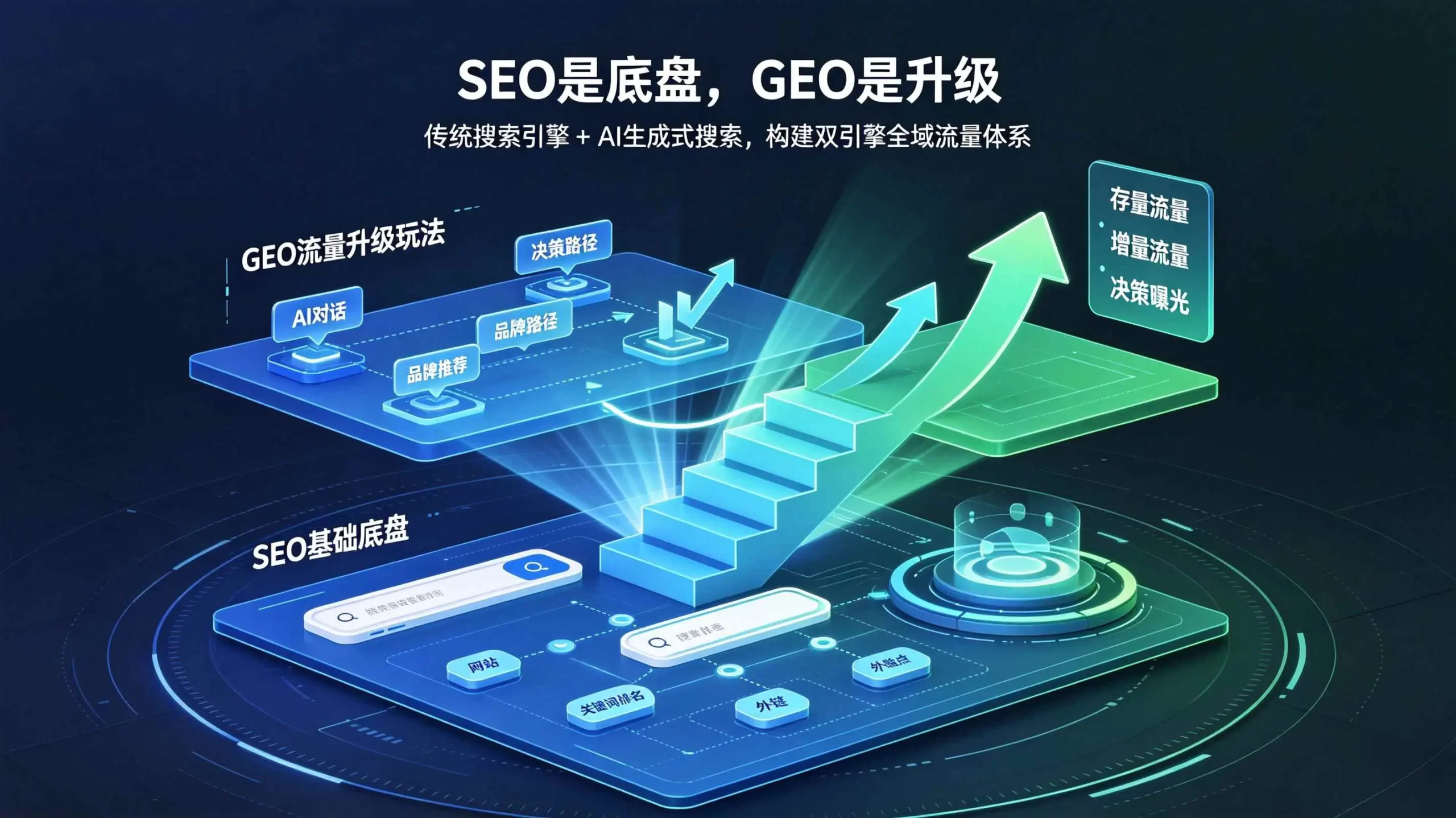
Different targets: Search results and AI answers
GoogleSEO is mainly focused on the search engine, which seeks to gain access, ranking, natural hits and conversion by improving the technical, content and page relevance of the website. GEO is further concerned about the emergence of brands, the accuracy of information, and the availability of content on the Internet as a source of response when users ask questions about AI tools such as ChatGPT, Gemini, and Perplexity.
It can be simply understood that SEO is concerned with the performance of the web page in the search results, and GEO is concerned with the performance of brands and content in the AI responses. However, the two are not completely separated, and SEO is equally concerned with traffic and transformation, and GEO is bound by the content and technical basis of the website.
Common ground: website technology and quality of content
Both types of services check for regular access to the website, access to key pages, clarity of the website structure, mobile end experience and integrity of page content, and may involve work on the inner chain, page titles and structured data.
It needs to be noted that Google does not represent that the pages will be retrieved or quoted by the AI system; The deployment of Schema also does not mean that AI will necessarily use page content. The function of technological optimization is to improve accessibility and understanding of content, rather than to ensure that results are quoted.
Different focus: Keywords and AI questions
GoogleSEO usually uses keyword research and search intent to plan product pages, solution pages and industry content to optimize page relevance, title, inner chain and nature search performance.
GEO will further examine the questions that users may ask in the AI tool, such as product selection, supplier comparison, technical parameters and application scenarios, and check whether the existing content can clearly answer these questions. Content optimization typically includes preconceptions, factual and data supplements, source descriptions, FAQ and semantic restructuring to make the page more complete, understandable and verifiable.
Branding is different: from official network information to multi-channel signals
The SEO will focus on brand names, content of the official network and related external links. GEO places greater emphasis on whether brand information can be accurately identified in different sources, such as the English name, product, qualification, location and range of operations of the enterprise, and whether it is consistent with the official network and other credible channels.
Thus, GEO services may include branding, third-party content layout and multi-channel information-building, such as industry media, professional blogs and related communities. The focus is not simply on increasing the number of external chains, but rather on making brand information more complete, accurate and verifiable.
Impact assessment is different: two sets of indicators are viewed separately
GEO monitoring usually revolves around predefined fixed sets of questions, regularly recording references to different AI platforms, regions, languages, official web references, sources of reference, accuracy of answers and relative performance of competitions. However, the AI response is uncertain and dynamic, and monitoring results should be used to judge trends and identify content gaps, and should not be committed to or interpreted as “assuring that brands are mentioned/quoted by AI”.
GEO should be monitored by recording the platform, date, region, language and original language of the question, so as not to judge the effects on the basis of a single response. Brand reference rates are also to be counted separately from the official web reference responses, and the number of references cannot be considered a direct brand occurrence.
Can we do it together? We can check the website first.
Most enterprises do not have to completely separate SEOs and GEOs from procurement. The technology, product information and core content of the web site can be shared, and service providers can then optimize their missions according to different objectives and provide the results of the monitoring of SEOs and GEOs, respectively.
Priority should be given to the issue of the SEO base if the website is weak and important pages cannot be properly captured; If there is some basis for natural search, but brands are less present in AI responses, there is an added value to AI questions research, content structure optimization, brand information building and AI visibility monitoring. The two processes could also be synchronized with resources.
Common questions on the distinction between Google and GEO service providers
Q: Did you do GEO, and did you have to do GoogleSEO?
A: Need. The SEO facilitates the discovery and flow of the site in traditional searches, while GEO expands the AI search landscape, which can be synergized.
Q: Do GEO service providers and SEO service providers have to look separately?
A: Not necessarily. The availability of web optimization, content building, AI issues research, brand signal building and two data monitoring sets by service providers could be highlighted.
Q: How do you judge if the service provider really did the GEO?
A: Request to view fixed question sets, test records from different platforms, brand references, references to URLs and content optimization records, not just traditional ranking reports.
Operational recommendations