
The way overseas users receive information is changing with the development of AI search and question-and-answer products such as ChatGPT, GoogleAIOverviews, Perplexity and others. GEO is becoming a focus of interest in the search and marketing of co-fertilizers and foreign-trade and manufacturing enterprises with a demand for overseas market expansion. Unlike traditional SEOs, which focus mainly on the visibility of pages and natural flows in search engines, GEO is more concerned about whether brands, products and professional content can be identified, referred to and quoted by AI search systems. However, GEO is not a simple substitute for SEO, and the technological basis, content quality and branding of the website remain important. So, what kind of work capacity, delivery content and impact data should be verified to determine whether a fully fertilized GEO service provider is professional?

Search and user research: moving from “keyword thinking” to “entity and intention identification”
The different AI platforms do not generate answers in the same way, and some of the platforms combine real-time search, external web search and existing knowledge generation of the model. GEO service providers therefore need to have search needs analysis and user intent research capabilities to understand the issues that target clients will raise around products, application scenarios, technical parameters and supplier selection.
Questioning intent and hint-scraping:
Service providers should collate questions that clients may have addressed to AI in the context of business products, target markets and procurement processes. For example, around hydraulic presses products, problems can be designed from the perspective of vendor screening, equipment tonnage, application scenes, technical parameters, after-sales support, etc., rather than just listing key words for the product.
- Suggested deliverables: Target client list, Prompt Introduction, Search Intent Classification and Corresponding Content Questions.
- Semantic entity mapping: Service providers need to combo the relationship between business brands, product names, product models, technical parameters, areas of application and trade terminology, ensure clear and consistent information expression in the official network and other open channels, and reduce confusion between brand and product information.
- Suggested verified deliverables: list of brands and product entities, core information tables, semantic linkage planning, and page content that needs to be supplemented or amended.
Technical basis of the website: ABI-friendly code and structured data
In order to increase the visibility of the website in the AI search scene, it is necessary to first check whether the site can be accessed properly, captured and analysed, and whether key product and business information can be presented through a clear page structure.
1. Structured data deployment
Service providers should be able to rationalize the use of Schema structured data based on page content, such as the types of Organization, Product, etc., to help search engines understand business and product information more clearly on the website. Structured data need to be consistent with the visible content of the page, but cannot be understood as an assurance that AI necessarily captures or quotes the page.
2. Page presentation of key information
Important information, such as product parameters, specifications, application scenes and technological advantages, should be presented as clearly as possible in HTML text and tables, not just in pictures, PDF screenshots or unreadable graphics. Service providers should also check page titles, text levels, internal links and mobile-end displays to ensure that information is easily readable by users and is easily understood by the search system.
- Suggested verified deliverables: website technical audit reports, focus page optimization lists, Schema deployment records and related page changes.
Professional content-building: building an E-E-A-T expert identity and knowledge base
GEO content building also requires attention to the professionalism, accuracy and credibility of information. For B2B manufacturing enterprises, real product parameters, application cases, technical experience and industry knowledge are more valuable than simply increasing the number of articles.
- Organizational content around procurement issues: Service providers should plan their content around the actual decision-making issues of the target client, such as product selection, comparison of technical parameters, application scenes, quality standards, production capacity and after-sales services. Articles require clear questions, factual evidence and clear response structures, rather than simply increasing the density of keywords.
- Suggested verified deliverables: content thematic planning, keyword and tipsheets, article outline, published page and content update records.
- Real experience and information-building: Enterprises can demonstrate their experience and operational capacity through technical team presentations, actual project cases, product testing data, industry standards and professional information. External information should be quoted by indicating the source and verifying accuracy, and it is not recommended that expert identities, client cases or industry endorsements be forged in order to project the image of the expert.
Brand coherence: a web-wide multi-channel node layout
Some of the AI search platforms generate responses in the context of official networks, media, social platforms and other public information. The external contact points for brand information may be limited if the business maintains only the official network. Therefore, GEO service providers also need to have multi-channel content planning and brand information management capabilities.
- Multi-channel content layout: based on target markets and client groups of enterprises, the network of planners, LinkedIn, YouTube, industry media and related professional communities. The content forms of the different channels may vary, but basic information, such as business names, product information, core business and contact details, should be accurate and consistent.
- Delivery recommended for verification: a list of channels, branding information specifications, content release plans and links to published content.
- Branding information checks: Introduction, product parameters, contact details and historical information in the network of periodic inspectors and major open channels, timely correction of errors or obsolescence. For pages of third parties that cannot be managed directly, questions should be recorded and viable corrections should be assessed.
Multi-platform monitoring and evidence tracking: capture of AI references and recommended developments
The effects of GEO cannot be judged only by the traditional keyword rankings, but also by the reference to the branding in the responses to different AI platforms, the citation of official web pages and changes in AI source flows. Service providers should establish regular monitoring problems and record-keeping to facilitate continuous comparison.
- Multi-model reference tracking: Service providers should be able to regularly test the target platforms such as ChatGPT, Gemini, Perplexity, GoogleAIOverviews to record whether brands are mentioned, official web pages are quoted, what is quoted, and whether competitions appear in the answer to the same questions. Cross-checking can be conducted in conjunction with GEO monitoring tools, manual testing and data available to the Platform.
- Suggested deliverables for verification: fixed typologies testing library, platform testing records, brand name references, reference page lists and competitive comparison results.
- Brand Visibility and Reference Page Analysis: The Reference to Brands in Periodic Statistical Targets, The Reference to Official Pages, and Differences in Performance of Different AI Platforms. Test questions, testing dates, platform names and response screenshots or links should be retained in the report to avoid giving only one unverifiable reference rate figure.
Effects over time and strategy over time: a long-acting dynamic eugenic mechanism
GEO is not a once-for-all project and, as the large model version evolves, service providers need to establish a long-term back-to-back mechanism.
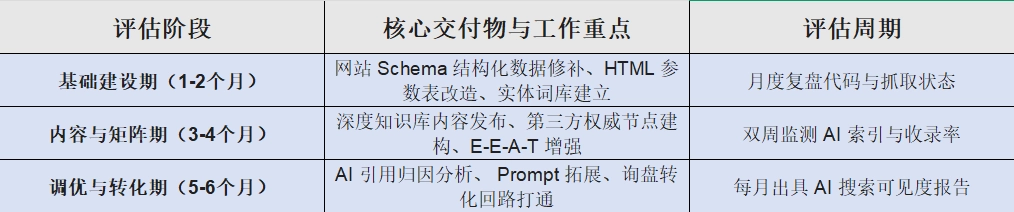
GEO optimization requires a “monitoring-analysis-adaptation-validation” cycle mechanism. Service providers should reset their brand reference rates, web reference pages, AI source flows, priority problem performance and competitive dynamics on a monthly or stage-by-stage basis to identify which elements are quoted, which pages lack supporting information and which channels need additional authoritative content.
On this basis, enterprises should continuously update product parameters, application cases, technical information and frequently asked questions, and adjust the content structure and information sources to the changes in the responses of the AI Platform. For better-performing pages, internal links, external references and multimedia materials could be enhanced; The content perspective, evidence intensity and distribution channels should be reassessed for topics that were not mentioned or cited in less detail.
Common questions about the capabilities of the co-fertilizer GEO service providers
Q1: is there a conflict between GEO and traditional GoogleSO? Do you need to do it separately?
A: The two are not in conflict and can be carried out in tandem. SEO focuses mainly on the visibility and natural flow of the website in the traditional search results, while GEO further focuses on references and references to brands and content in AI search responses. The technical basis of the website, the quality of its content and the construction of brand information are both helpful. Enterprises can develop synergistic programmes between SEOs and GEOs, taking into account existing web sites and overseas outreach objectives.
Q2: How do you verify that the AI quotes submitted to me by GEO service providers are true?
A: The service provider may be required to provide fixed test questions, test platforms, test dates, target areas, AI response intercepts or shared links, as well as the appropriate reference page. For data generated by third-party tools, the statistical calibration and the scope of the test should also be specified. Due to the dynamic nature of AI ' s responses, a single screenshot can only support a test result and cannot directly represent long-term performance.
Q3: How long does a traditional manufacturing company do GEOs and usually see effects?
A: GEO does not have a fixed life cycle for all enterprises. The website base, the quality of content, industry competition, the Target AI platform and its retrieval mechanisms all affect progress towards optimization. Enterprises can establish baseline data on brand references and references at an early stage of the partnership, followed by monthly or phased observations of changes. For platforms with real-time search capabilities, some pages may be given early reference opportunities, but this does not mean that brand references and stable references can be achieved within a fixed time frame.
Operational recommendations