
Two weeks after the SEO service was launched, the question began to be “Why isn't it on the front page”, a situation that many companies would have encountered when they were doing GoogleSO. GoogleSEO, unlike the ads, can get a hit when it's on. The search engine needs to find pages, capture content, create an index, and then rank according to relevance and competition. As a result, GoogleSEO had no uniform answer for the time of effectiveness, which was usually influenced by the basis of the website, the competition of keywords and continued performance. Rather than focusing on the length of the first page, it would be preferable to make clear what changes should be seen at different stages and how to judge the effectiveness of the optimization exercise.

Website basis: New station and old station starting point different
The website base will affect the SEO optimization cycle.
New independent stations usually require improvements to the web structure, page content and basic technical set-up to enable Google to normally discover and access pages. Old stations with a certain amount of recording and natural flow can be adjusted on the basis of the original, but a large number of duplicate pages, dead chains, capture anomalies or content quality issues need to be addressed first.
Therefore, it is not easy to judge the progress of other websites by their optimal cycles.
It is recommended that the first steps of the collaboration be to examine web site entries, natural search performance, focus pages and technical issues, and to establish pre-optimization data baselines to facilitate subsequent comparisons.
Keyword competition: Different words are effective at different speeds
The degree of competition for keywords can also affect GoogleSEO ' s time of effectiveness.
For example, industry cores are often more competitive, and search results may have included a number of websites that have been in operation for many years. The new page needs to be continuously improved in terms of content and page quality in order to achieve better ranking.
By contrast, long end words such as specific models, application scenes, product specifications, etc., have clearer search intentions and competition for some sub-words is relatively low.
It is suggested that the long end words that clearly define the intent of the procurement be drawn up before the core keywords are progressively expanded. The ranking of the core words should not be the only test in the previous few months.
Technical optimization: addressing the issue of website base first
Technology optimization mainly addresses the issue of Google ' s regular access, capture and understanding of the website.
Common jobs include:
- Checks robots.txt, site maps and page capture settings;
- Checking death chains, repeating pages and 404 errors.
- Optimizing page titles, descriptions and inner chain structures;
- Checks for mobile end appliance and page loading;
- (b) Rationally refine the structured data according to the page contents.
After the technical problems have been repaired, it will be necessary to observe whether Google has reticked the page and whether there has been an improvement in the reporting and indexing of errors. However, it should be noted that the regular ability of pages to capture and record does not mean that they will always be ranked. Follow-up will continue to need to improve search competitiveness through content and page optimization.
Update: Continuous accumulation of natural search performance
The content building is not simply an increase in the number of articles, but a refinement of product information and solution content around the search needs of the target clients.
For foreign-trade enterprises, emphasis can be placed on optimizing product pages, application scene pages, solutions pages and industry articles.
For example, product pages could complement specifications, scope of application, authentication information and frequently asked questions; Existing articles can be updated to add missing information based on search performance.
It is often more targeted to check whether existing pages meet user search needs than to publish new articles blindly.
In addition, the planning of keywords, page optimization, updates and external content-building require continuous collaboration. SEO is not a few articles that can be done.
Phased indicators: Distinguishing entries, exposures, flows and questionnaires
Assessment of the time frame of the SEO results should not be limited to the ranking of keywords or the number of queries. It is suggested that there should be four levels of observation:
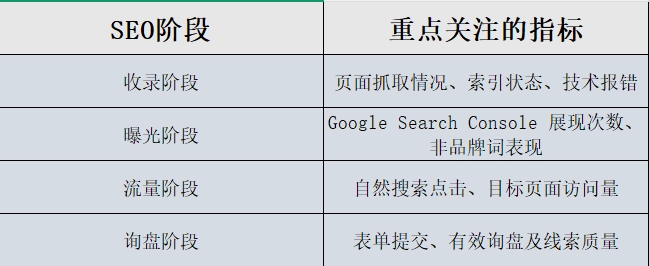
These stages do not necessarily occur in a strict sequence, but may also change at the same time.
For example, the pages are already available but are not visible for the time being and may be related to keyword competition or content matching; (a) Exposure without a click, which allows the title and description to be checked; There are natural flows without a Queries, and further examination of product pages, trust information and contact access is required.
Natural flow growth is only an intermediate indicator, and eventually the business value of SEO will be judged in relation to the quality of the actual queries.
Periodically revisit: aligning optimization with data
The SEO optimized cycle is long and the decline in rankings in a given week should not lead to frequent changes in page direction.
It is recommended that key data be reviewed on a monthly basis and that a quarterly, phased review be conducted, with a focus on:
- (a) The inclusion and presentation of changes in focus pages;
- The ranking of target keywords and the performance of clicks;
- Whether natural search flows have increased;
- Which pages bring a valid query;
- Whether the work done to optimize has produced the expected changes.
If access and exposure are not improved in the long term, technical issues, keyword selection and content quality need to be examined; If the flow increases but the query does not change, the page conversion links should be further analysed.
The monitoring of rankings needs to be combined with long-term trends, and it is not recommended that the optimization be based on a one-day ranking cut-off.
It's a common question about how long GoogleSEO optimizes can see effects.
Q: How long has GoogleSEO been effective?
A: There is no fixed time for all websites. There will be differences in the optimal cycles between new stations, old ones and key words at different levels of competition. It is recommended that the assessment be phased in in combination with the recording, exposure, flow and queries.
Q: Can an increase in the budget shorten the SEEA optimization cycle?
A: The budget cannot directly purchase natural rankings, but it will affect technological adaptation, content capacity, page optimization and the scale of implementation of external resource inputs; The end result will continue to depend on the basis of the website, the quality of its content, the competitive environment and its continued implementation.
Q: How often do you check the SEO data?
A: Significant anomalies can be monitored on a weekly basis, data analysis carried out on a monthly basis and overall trends reviewed on a quarterly basis. The focus is on maintaining consistency in the statistical calibration and avoiding short-term fluctuations in judgement.
Operational recommendations
GoogleSEO does not have a uniform answer for the time of the event. Rather than measuring the effectiveness of the service by using “a few months to the front page” only, enterprises should be more concerned about whether there is a reciprocable progress at each stage.
The GoogleSEO service, hosted by Anhui, is organized around website audits, competitor analysis, keyword research, page optimization, content output and data analysis. In the course of their cooperation, enterprises can judge the progress and the impact of the implementation process in the context of the optimization of records, the SaarchConsole data and the actual queries.